

Eagle Man Guide waited by the tree as the Seeker approached.
She was walking too quickly, her body already braced against what had not yet been spoken. She could feel it in the air before she knew its name. Loss was coming. Some part of her knew it. Some part of her had known it before she woke.
Eagle Man Guide did not greet her with words. He simply opened the way, and together they descended.
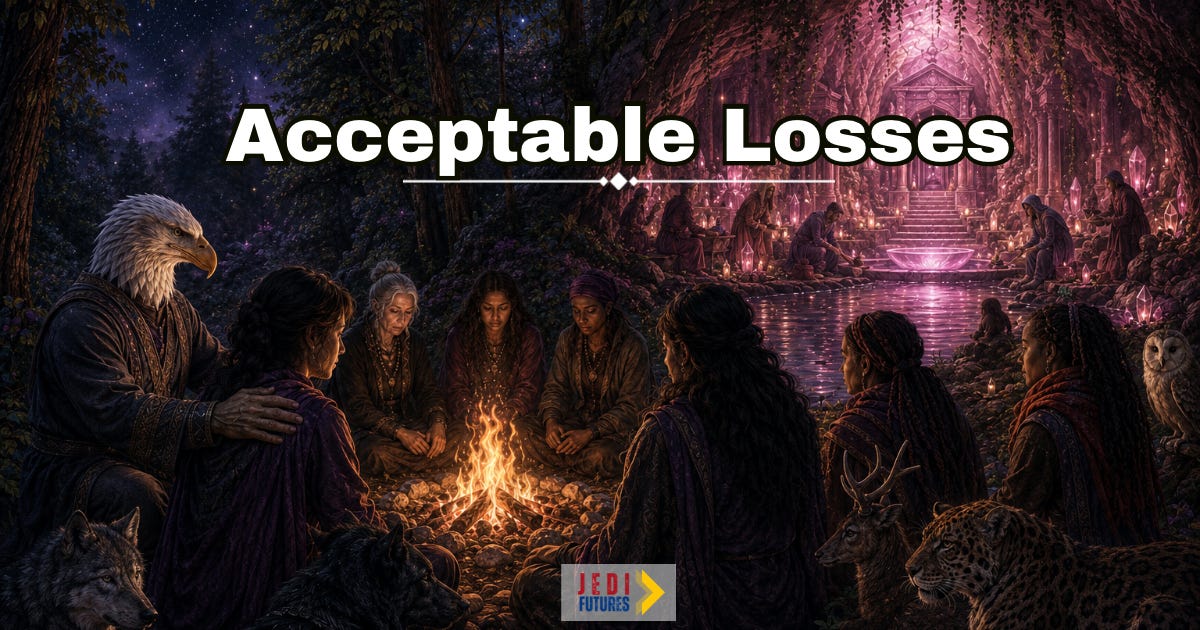
When they reached the underworld, night had fallen in the forest. The trees stood dark and listening. In the distance, a campfire burned low and steady, its light flickering against the trunks like a heartbeat. Around it sat Hecate, Sitri, and the others, their faces half-shadow, half-flame. The animal companions lay nearby, quiet and watchful.
No one was speaking, they were all staring into the fire. The Seeker looked around the circle, counting without meaning to count, and then her heart stopped. One of them was missing.
“Where is Merrilyn?” she asked.
The guides lifted their eyes.
“Merrilyn is gone,” Hecate said softly. “She has been lost in this battle.”
The words landed like a stone dropped into deep water. The Seeker sat heavily on a log, as if her bones could no longer hold her upright. She stared into the flames with the others. Merrilyn had been here, and now she was not. A presence had become an absence. A voice, a laugh, a certain light in the world—gone.
Inside the Seeker’s heart, a small spark lit itself. Not joy. Not comfort. Memory. She remembered Merrilyn’s particular energy, the way she carried beauty as if it were a form of courage. The way she made the hidden things glow. The way she moved through the secret life of the world with wonder, purpose, and a fierce devotion to freedom.
Eagle Man Guide stood behind the Seeker and placed his hand on her shoulder. He offered no explanation. Only the comfort of staying.
Slowly, someone reached for another hand. Then another. Around the campfire, the circle joined itself together. A low hum began, almost too quiet to hear at first. It moved from one body to the next until it became a single sound, rising out of them like the deep vibration of the Earth itself. They rocked as they hummed. Some forward and back. Some side to side. Each body followed the grief in its own way until, after a little while, they were moving together, like wind passing over a field of wheat.
As they mourned Merrilyn, they began to speak her name into the fire. They remembered Merrilyn, who first showed the Seeker the Temple of Freedom. Merrilyn, who had carried glowing rocks and crystals and geodes out of the cavern and into the sun. Merrilyn, who had watched the light catch inside them and scatter like fireflies on a summer night.
They remembered her joy of living. They remembered her deep stand for justice. They remembered how fiercely she believed in the freedom of all people—not as an idea, but as a sacred condition of life.
The Seeker looked up and caught Eagle Man Guide’s eyes. He stood just beyond the circle, watching over the ritual. He gave the smallest nod, almost imperceptible. And in the Seeker’s mind, a phrase bloomed.
Acceptable loss.
The words chilled her. She knew the phrase from the language of war. Acceptable loss: the measured cost of battle, the number of lives leaders decide can be spent in pursuit of an objective. The phrase carried the coldness of distance, the arrogance of calculation, the lie that some deaths can be folded neatly into a plan.
But here, beside the fire, the phrase changed shape. There was another kind of acceptable loss. Not the kind chosen by generals or justified by institutions. Not the kind that treats a human life as a cost of doing business. This kind of acceptance comes after loss has happened. The acceptance no grieving heart wants, but must eventually face: that the beloved is gone, and reality cannot be bargained with.
The Seeker turned toward the wise women. “How did Merrilyn die?”
Their eyes were mournful. “She was killed in an act of violence,” Sitri said.
The Seeker gasped. No. Not Merrilyn. Not like that. She had imagined Merrilyn leaving at a ripe age, in sleep, or at a time of her own choosing, when her work felt complete and her spirit was ready to cross. She had imagined a doorway, not a rupture. A blessing, not a wound.
“Who did it?” the Seeker asked, though even as the question left her mouth, she felt the danger inside it. The hunger for a villain. The desire to put the unbearable into a single body.
Hecate’s face remained steady.
“Merrilyn was doing what Merrilyn did,” she said. “She was helping someone through transformation. But when the person became terrified in the transformation process, they tried to stop it. They killed her as if killing Merrilyn could stop what was already changing.”
The Seeker looked around the circle, her eyes wide, filling again with tears. How could any life lost to violence ever be acceptable? The question tore through her.
The circle tightened. The wise women drew close. The animal companions pressed nearer. Together, they bent into their grief, swaying beside the fire. For a while, all their stories of Merrilyn’s joy and beauty and life were swallowed by the fact of violence. The celebration broke open into anguish. They cried until there were no tears left near the surface. Then, slowly, Eagle Man Guide rose and the others with him.
It felt right to go to the place Merrilyn had loved. The place she had revealed. The place where she had helped them see that freedom was not a slogan carved in stone, but a living light hidden inside and beneath the structures of power. So they began the journey to the Temple of Freedom, the cavern beneath the Capitol, the sacred under-place where Merrilyn’s joy had once overflowed.
They walked through the forest entrance, not the waterway that had also been Merrilyn’s playful route. They walked hand in hand, humming again as they moved, like children on a field trip and mourners in a procession and pilgrims carrying a flame through the dark.
When they reached the cavern, the Temple of Freedom was glowing a soft pink. At the center, the pool of water shimmered. Sparks of light flickered here and there, as if fireflies had come to live inside the stone, each offering its own small radiance. The helpers came forward and surrounded the pilgrims. They offered water and warm cloths, fruit and blankets, quiet hands and open arms. They moved with Merrilyn’s kind of tenderness, honoring her not by speaking loudly of her goodness, but by practicing it.
Together, the mourners sat around the pool and closed their eyes. They breathed into the loss—not only their own loss, but the world’s loss. The loss of one who helped others become more free. The loss of one who knew how to bring hidden light into the open. The loss of one whose life had been an offering.
The Seeker felt the truth rise inside her. She would have to accept this loss. Accepting was not approval. It was not excusing the act. She would not call it necessary. She could accept it only in the sense that she could not undo it. And this acceptance hurt. With the acceptance, her sense of safety was shaken. This loss shook her willingness to keep helping people to transform. It made her see how fragile a person can feel when violence enters the story.
Feeling safe in society suddenly seemed like a luxury from another age. At least at this moment.
The Seeker placed her hand over her heart and asked herself what Merrilyn would do. The answer did not come as a command. It came as a warmth. Merrilyn would share her courage.
The Seeker understood then that she could borrow Merrilyn’s courage when her own felt too small. She could carry a spark of Merrilyn’s light into the work ahead. Not because she was unafraid, but because fear did not get to decide what was sacred.
Would there be risks? Of course.
Would there be more loss? Probably.
Could they still continue the transformation? In her heart, the answer rose full-throated and alive. Yes.
The transformation was already underway. Those who help others transform are visionaries of a future where all can thrive. They are midwives of the becoming world. They stand near the trembling places and help people cross.
And those who become too afraid, those who lash out violently when change asks too much of them, are not made less responsible by their fear. But they are also not beyond understanding. Fear can turn people into weapons when no better path is offered. Fear can make a person believe that killing the guide will kill the transformation.
But transformation, once awakened, does not die so easily.
The Seeker looked around the circle.
She saw Hecate. Sitri. Eagle Man Guide. The animal companions. The helpers. The companions of the secret life. She saw grief on every face—and beneath it, something else began to surface. Quieter than resolve. More durable than courage.
She felt a willingness to stay. The work of carrying Merrilyn’s light forward was not hers alone. It never had been. This was the teaching she had almost missed inside her grief: no single person could hold the whole transformation. No single person should have to. It would be held by circles, by communities, by people brave enough to gather around a fire, speak the truth, mourn what had been lost, and still return to the work of life.
This was how violence would fail to spread. This was how grief would become a vow.
Around the pool in the Temple of Freedom, the Seeker let the larger vision move into her—not over her. Into her. It did not erase the pain. It gave the pain somewhere to root. Merrilyn’s light had not gone out. It had entered the circle. And there, in the soft pink glow beneath the structures of power, the Seeker found her way back to the hardest kind of acceptance.
Merrilyn was gone. Merrilyn mattered. Merrilyn’s work remained.
And they would carry it together.