

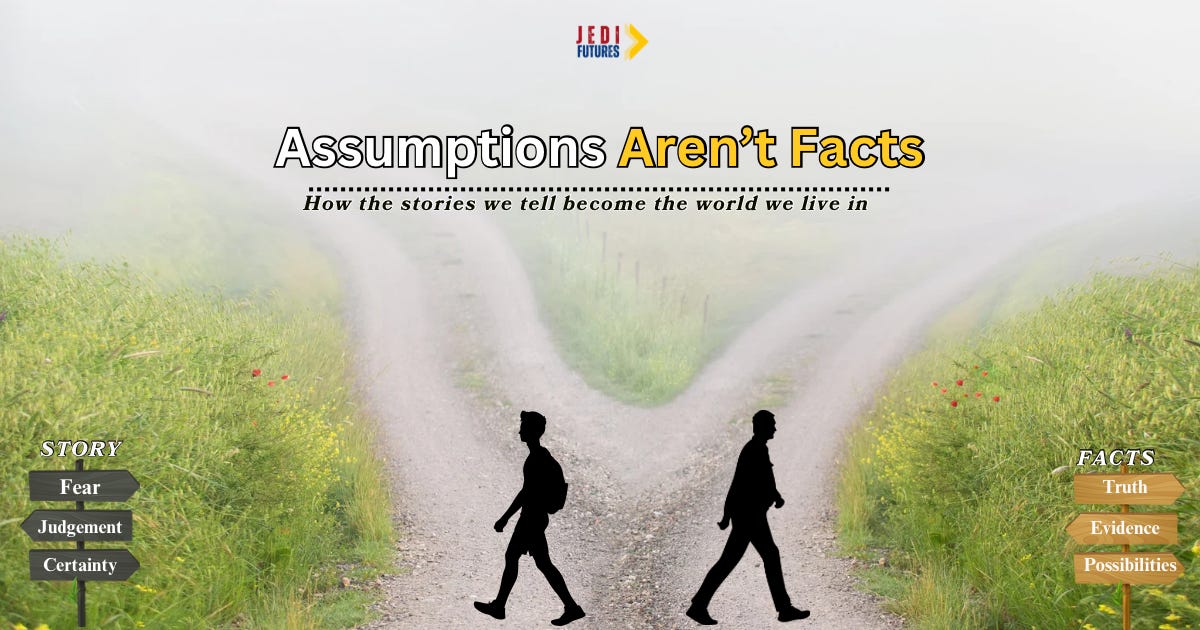
I used to believe I was a victim of child abuse.
Growing up, I received “corporal punishment” in the form of spankings—by hand, spoon, and belt. As I got older, I gathered allies to confirm my belief: a school counselor, a therapist, friends. The evidence felt obvious. I carried that belief into adulthood, pulling it out whenever I felt wrongly “punished” by circumstances—or by people with authority.
For me, this “fact” was undeniable.
But was it a fact?
Most of us mix up what happened with the story we tell about what happened until we can’t tell the difference. That’s how assumptions form. They become our invisible operating system—running in the background, shaping our reactions, filtering what we notice, and deciding what we call “reality.”
And once an assumption settles in, we stop inspecting it. It calcifies into: This is just how the world is.
About 25 years ago, while training to become a life coach, I got an assignment that sounded simple: find an assumption you treat as a fact and test it. In a small group, mine surfaced quickly:
“I was abused as a child.”
I procrastinated for weeks. It felt too obvious to examine. It was my precious—my proof, my shield, my explanation.
Eventually, my desire to be a “good student” overcame my resistance. I sat down with three questions:
Why do I hold this belief? Is it true?
What evidence supports it?
What evidence contradicts it?
I skipped the “why” and went straight to my list of proof:
My school counselor told me it was true.
My therapist agreed.
I have a scar on my chin from one incident.
I remember the spankings in all their forms.
Then I tried to list evidence that contradicted my belief.
Nothing.
So I returned to the question I’d avoided: Why do I hold this belief?
And my pen wrote something that stunned me:
“I want to believe this so I can feel superior to my step-dad.”
What???
I had been holding onto a wound—not just because it hurt, but because it gave me a position: moral high ground. A story where I was unquestionably right and he was unquestionably wrong. A story that made me feel powerful in a place where I once felt powerless.
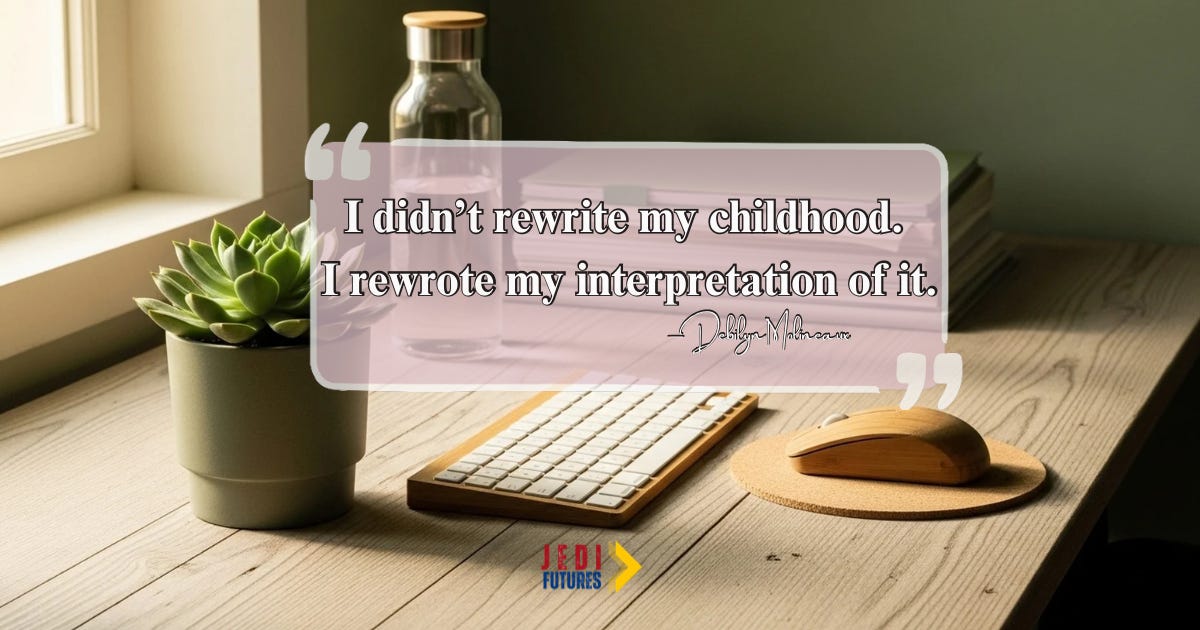
In that instant, something shifted. I didn’t rewrite my childhood. I rewrote my interpretation of it. My belief moved from “I was abused” to something closer to:
“I was punished in ways I didn’t like or agree with, and I survived. I like who I am today.”
Forgiveness was immediate. For him. For myself.
A couple of weeks later, my mom walked into the room, looked at me, and said, “What’s changed? You look lighter.”
That was all the confirmation I needed: an operating system had updated. A belief I treated as a fact had been running my life—and I hadn’t even seen it.
Which brings me to now.
When I heard about the killing of Renee Nicole Brown in Minneapolis on January 7, 2026, I felt my nervous system do what it always does: reach for a story fast—one that explains the world and protects me from feeling helpless.
A set of “obvious truths” arrived, fully formed:
The government is not trustworthy under Donald Trump.
Any use of force by ICE against immigrants or citizens is bad.
Cruelty is intended to force compliance.
Nice women don’t get randomly killed by authorities.
Some of these might be true. Some might be partly true. Some might be my fears.
But here’s the point: they’re not raw facts. They’re interpretations. Frames. Meaning-making.
And frames matter—because once a frame locks in, it decides what evidence counts, what doesn’t, and who we can still see as human.
If we’re going to examine assumptions, we have to do it across the aisle
This is where I want to be brave: if I can audit my assumptions, I have to be willing to imagine what assumptions someone on the other side might be carrying, too.
Here are examples of underlying assumptions a MAGA-leaning person might sincerely hold—not as a caricature, but as a real operating system (ChatGPT helped here):
Institutions lie to protect themselves (government, media, universities, “experts”).
Chaos is rising, and order must be restored—even if it takes force.
Borders are basic fairness; if rules aren’t enforced, society collapses.
The system is rigged—and polite leaders won’t fight hard enough to fix it.
Ordinary people are being silenced by cultural rules they didn’t consent to.
My community is disrespected—and someone finally defends it.
And on the anti-Trump side (including many of my own reflexes), a different operating system often runs:
Strongman leadership is inherently dangerous.
Federal force is more likely to abuse people than restrain itself—especially against the vulnerable, with a strongman leader.
Cruelty is strategic—a deliberate tool to intimidate and dominate.
If it feels authoritarian, it probably is.
Different assumptions. Different “obvious facts.” Different realities.
A simple invitation (and a practice)
Pick one belief you’ve been carrying like a rock in your pocket. Write it as a sentence:
“The government can’t be trusted.”
“The media lies.”
“Cruelty is the point.”
“If we don’t enforce the border, nothing else matters.”
“They’re coming for people like me.”
Then ask:
What are the observable facts I actually know? (Not conclusions—just what happened.)
What story am I telling about those facts?
What does this story protect me from feeling? (fear, grief, shame, helplessness)
What does this story allow me to feel? (superior, moral, righteous)
What evidence supports my story?
What evidence could contradict it—even slightly?
Sometimes, it’s time for an update. This isn’t about losing passion. It’s not about “both-sides-ing” reality. It’s about reclaiming our agency—so our assumptions don’t drive our lives without our consent.
And this is where examining assumptions stops being self-help and becomes future-making. The life we’re walking toward—at home, in our communities, in this country—will be built out of the beliefs we treat as unquestionable. If our operating system says people can’t be trusted, we’ll design a life of walls. If it says cruelty is inevitable, we’ll start accepting harm as normal. If it says only force works, we’ll reach for force faster and more often. But if we can pause and separate fact from story—if we can soften our certainty just enough to see a wider set of possibilities—then we can choose beliefs that generate the future we actually want: more courage than contempt, more repair than punishment, more truth than adrenaline, more neighborliness than suspicion. This practice is how we stop living as characters trapped in old scripts and start living as authors again—writing a future life that has room for dignity, complexity, and each other.
Please share your thoughts, I’d love to hear from you. Please private message me or comment below.