

My Take
I am angry, sad, and disappointed. Again.
My one solace: Todd Blanche appears to be following John Mitchell’s path. Patience is required — corruption won again this week. A refresher: John Mitchell was Nixon’s Attorney General, and before that, his personal lawyer. History doesn’t repeat, but this is a strong rhyme, and the only reason is cover-up.
Why did Senators who claimed to be “concerned” about Blanche’s nomination lack the courage to vote no? Did they care more about killing a $1.8 billion slush fund for insurrectionists than about Epstein survivors? What about immunity for the president and his family from IRS audits? These things shouldn’t be contrasted with each other. They are a trail of ongoing corruption. The Senators had the power to say no. They said yes.
Two days before the vote, a judge ruled that the Blanche-led DOJ had failed to follow the Epstein Files Transparency Act. He wasn’t speaking without evidence — he had demanded, received, and reviewed the unredacted files that journalist Katie Phang is fighting to make public. His ruling: DOJ failed to comply with his order to explain each redaction. They have to try again. Blanche never blinked. The Senators did. Then they confirmed him as the country’s top law enforcement officer.
Power, wealth, and privilege know how to run out the clock. Blanche promised to “follow the law.” He never mentioned that laws can change.
I also read the Senate report Oregon Senator Ron Wyden released. In 67 pages, he outlines decades of bankers protecting Epstein as a client — and wanting his referrals, especially to Leon Black. JPMorgan Chase had eventually banned Epstein. He worked around it through Black’s accounts and kept doing business with Chase anyway. The report is damning. The banks didn’t report what they knew, and there appears to be evidence to convict people. That would take Treasury investigating and DOJ giving a damn. They won’t. They don’t believe the rule of law applies to people like this.
Keep pressuring for transparency. Stay focused. This case will expose everyone who believes themselves above the law, eventually. I hope they’re still alive to be held accountable. For what it’s worth, Mitchell served 19 months for conspiracy, perjury and obstruction of justice. I’m looking forward to that trial.
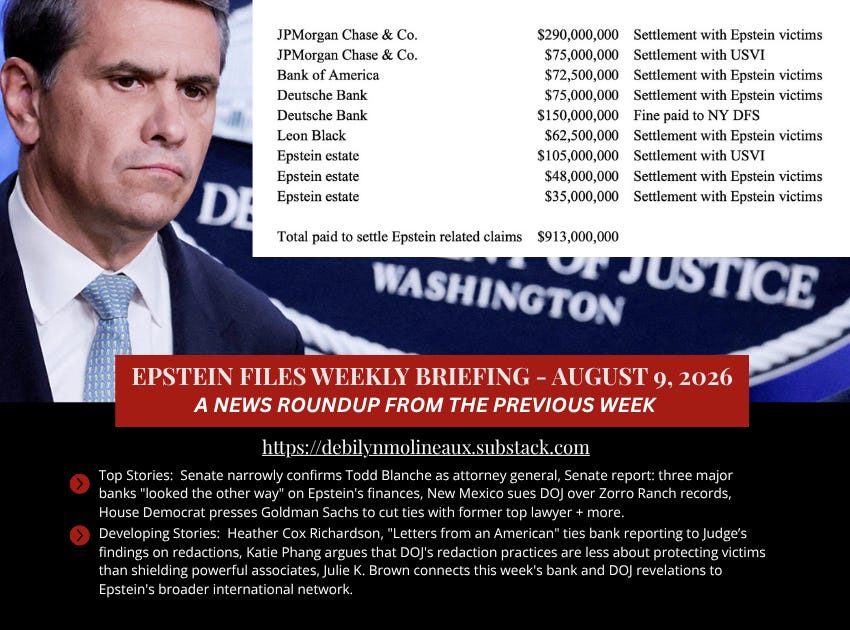
Top Stories
Senate narrowly confirms Todd Blanche as attorney general, days after a judge found he’d conceded a transparency-law violation. The Senate voted 50-49 early Saturday, August 8, to confirm Blanche — Trump’s former personal criminal defense lawyer — as permanent attorney general, capping a bruising fight. Only Republicans Susan Collins and Lisa Murkowski voted no, joining all Democrats; Sen. Bill Cassidy (R-LA) supplied the deciding vote after publicly wavering through the week. The confirmation came just days after Judge Emmet Sullivan found, in the Katie Phang lawsuit, that Blanche had effectively conceded DOJ violated the Epstein Files Transparency Act by redacting material under an exemption the law doesn’t contain. Murkowski cited DOJ’s Epstein files handling directly among her reasons for opposing him, alongside concerns about immunity protections for Trump and his family. Blanche countered that DOJ undertook a “Herculean task” reviewing millions of files and has “been more transparent than any past administration” on Epstein. Senate Democrats framed the vote as an endorsement of a cover-up: Schumer said it “green lights” Trump’s “pervasive, breathtaking corruption” and argued “you can’t have the president’s personal attorney as the Attorney General”; Sen. Jacky Rosen cited Blanche’s “complete and total mishandling of the Epstein files.” Epstein survivors, who had urged senators to vote no after calling an earlier meeting with Blanche “condescending and evasive,” said in the confirmation’s aftermath that DOJ continues to fail them. Washington Post | NPR | CNN | NBC News — Murkowski | The Hill — Democrats react | 19th News — survivors | Truthout — survivors
Senate report: three major banks “looked the other way” on Epstein’s finances. Sen. Ron Wyden (D-OR), ranking member of the Senate Finance Committee, released a four-year investigative report on August 4 titled “Looking the Other Way: How Wall Street Banks Enabled Jeffrey Epstein’s Sex Trafficking.” It alleges JPMorgan Chase delayed reporting over $1 billion in suspicious Epstein-linked transfers (including payments to women in Russia and Belarus), Deutsche Bank failed to timely report more than $250 million in suspicious wires, and Bank of America failed to properly screen and report $170 million in payments, including to associate Leon Black. The report concludes bank executives knew of Epstein’s suspicious activity for years but withheld it from regulators. Wyden is calling on federal regulators to investigate. Bloomberg | NPR | Axios | Senate Finance Committee release
New Mexico sues DOJ over Zorro Ranch records. On August 5, the New Mexico Department of Justice filed a federal lawsuit against Acting Attorney General Todd Blanche and DOJ, seeking unredacted investigative files tied to Epstein’s Zorro Ranch property, which state prosecutors reopened a criminal investigation into in February. The DOJ’s released files reportedly contain over 13,000 references to Zorro Ranch and 5,000 references to New Mexico as trafficking locations. The state argues DOJ’s refusal to share unredacted materials violates the Administrative Procedure Act and interferes with its sovereign prosecutorial authority. DOJ maintains the Epstein Files Transparency Act and protective orders bar it from releasing victim-identifying information. CNN | NBC News | New Mexico DOJ press release
House Democrat presses Goldman Sachs to cut ties with former top lawyer. On August 7, Rep. Robert Garcia (D-CA), ranking member of House Oversight, sent Goldman Sachs CEO David Solomon a letter urging the bank to sever all remaining ties with former chief legal officer Kathy Ruemmler, following her closed-door committee testimony. Garcia called her testimony “nothing short of shocking,” citing jokes she and Epstein exchanged about his criminal history and her attacks on accuser Virginia Giuffre’s credibility. He set an August 21 deadline for Goldman’s response. This follows a wave of criticism after transcripts of Ruemmler’s testimony were released in late July, in which she said Giuffre’s abuse allegations “lacked inherent credibility” — prompting a rebuke from Giuffre’s family. CNN
DOJ’s court fight over redactions continues. The Katie Phang v. Blanche lawsuit — which forced DOJ to hand a federal judge unredacted Epstein documents for private review in late July — remains active. U.S. District Judge Emmet Sullivan has ordered both sides back in court after DOJ failed to fully document its justification for contested redactions, including material related to a “torture video,” sexual activity involving minors, and interviews with a woman alleging abuse by President Trump as a minor. Acting AG Blanche is separately seeking relief from a $1,000-a-day contempt fine tied to the case. A further hearing is expected in the coming week. The New Republic | The Hill
Developing Stories
Fact-based opinion and analysis from independent journalists, offered as informed speculation rather than confirmed reporting.
Heather Cox Richardson, “Letters from an American” (Aug 3, 4, 7). Richardson ties the Wyden bank report directly to the ongoing Blanche/Phang court fight, arguing Judge Sullivan’s findings amount to Blanche effectively admitting DOJ violated the Epstein Files Transparency Act. She frames the week’s developments — the banks report, New Mexico’s lawsuit, and the court order — as converging evidence that institutional actors (banks, DOJ) knowingly protected Epstein’s network for years. August 3 letter | August 4 letter | August 7 letter
Katie Phang, independent journalist and litigant. As both a reporter and the plaintiff forcing DOJ’s document disclosures, Phang continues to argue via her Substack and public commentary that DOJ’s redaction practices are less about protecting victims than shielding powerful associates. Her running commentary on the Sullivan hearings is one of the more granular independent trackers of the unredaction fight. Katie Phang Substack
Julie K. Brown, “The Epstein Files.” The Miami Herald journalist whose reporting originally reopened the case continues longer-form analysis connecting this week’s bank and DOJ revelations to Epstein’s broader international network, arguing that financial-sector accountability (the Wyden report) is the underdeveloped half of the story relative to political accountability. Julie K. Brown Substack
Media Coverage Analysis
This week’s coverage split along two axes: institutional accountability (mainstream outlets, led by the bank, New Mexico, and Blanche confirmation stories) and elite-protection framing (independent/opinion writers). Mainstream outlets — CNN, NBC, Bloomberg, NPR, Axios, Washington Post — largely covered the Wyden banking report, the New Mexico lawsuit, and Blanche’s confirmation as straight accountability stories, with heavy reliance on official documents (the Senate report, court filings, floor votes) rather than anonymous sourcing, giving this week’s reporting an unusually verifiable, paper-trail-driven character compared to earlier phases of the story.
The Blanche confirmation was the week’s clearest test of how outlets handle a direct collision between a legal finding and a political outcome. Mainstream coverage largely let the juxtaposition speak for itself — reporting Judge Sullivan’s finding and the confirmation vote as sequential facts — while leaving interpretation (”does this amount to the Senate rewarding non-compliance?”) to quoted senators (Murkowski, Schumer, Rosen) rather than reporters’ own framing. Outlets aimed at progressive or survivor-focused audiences (19th News, Truthout, Ms. Magazine) were more willing to state the throughline explicitly in their own voice — that confirmation happened despite, not separately from, the transparency-law finding.
Independent and opinion writers, by contrast, focused on connecting the dots between individual revelations to argue a pattern of systemic protection — framing this week’s DOJ redaction fight and the bank revelations as two fronts of the same story: institutions (financial and governmental) shielding Epstein’s network rather than a single “bad actor” narrative. This echoes a critique that has recurred in academic and press-criticism circles this year (e.g., LSE Media Blog, February 2026) — that a lot of 2025–26 coverage over-individualized Epstein himself at the expense of examining the “architecture” (banks, law firms, government redaction practices) that enabled him. This week’s stories are a partial correction to that pattern, since both major mainstream stories (Wyden report, New Mexico suit) are institutional rather than personality-driven.
One notable coverage gap: little mainstream attention this week to the Maxwell pardon question specifically, despite it remaining a live political issue — most Maxwell coverage this week was recirculation of the late-July Senate resolution rather than new reporting, suggesting a natural lull between congressional actions.
Compiled from mainstream news coverage and independent journalism by Claude and edited by Debilyn Molineaux. All claims sourced above; speculative claims are flagged as such in context.