

I’ve been triggered a lot recently. Maybe you have too?
The stars and planets indicate big, belief-shattering changes are happening. I can’t help but wonder if my heart’s desire to end the patriarchy will be the biggest change of all. The patriarchy is my catch-all phrase for the societal hierarchy that values some humans more than others — giving power to a few people who then act as though the rest of us should go along with their dominance. I’m ready for these beliefs to shatter, or at least be diminished as an aberration in our collective psyche.
The patriarchy has led us astray of our democratic principles in the United States. Or perhaps we’ve never followed them fully. Regardless, I find myself alternating between joyous hope for a new society and grief for the loss of the good parts we’ve had. I’m irritable and cranky. My yo-yo emotions show up in the oddest of ways. One moment I’m admiring my partner’s work and contribution. The next I’m picking a fight because he “asked” me to make him popcorn and won’t take no for an answer. It’s a small task that takes a few minutes. But it’s the double standard — where he can say no when he’s at his limit but I cannot — that I find unacceptable. I want equality in having boundaries between us.
In short, I don’t want to be dominated. Do you?
Domination is when I believe or feel I don’t have agency over my own thoughts and actions. I am forced or coerced into doing or saying things. Sometimes I stifle my tongue to keep the peace. Other times it’s making the popcorn before bed with a heavy dose of resentment for added seasoning — resentment I’ll carry for days. So is the problem personal or societal? It is both. Societally, we expect certain people to act certain ways, calling them out when they exhibit their own agency to act differently from our expectations. Democratic principles have been hollowed out for societal and political domination. A fear-based, power-over hierarchy has been substituted for leadership, replacing earned respect and public service. We need a path out.
For the last decade or so, our electorate has rewarded bullying, intimidation, and dehumanization tactics. We’ve been exposed to toxic masculinity through the erasure of DEI programs, the military “man-up” approach, and of course, the Epstein files. And those in power keep doubling down — dominating more space, more culture, more buildings, and yes, the democratic practices of our country. The public battles where authoritarians are cloaking themselves in democratic principles are many:
Redistricting, election laws, and voter ID mandates
Litigation against people and companies who dare to speak against the leaders
Public spaces with visual cues about the current leader
Firing public servants without following democratic process
So. Many. More.
If democracy survives, it will take a miracle. And by miracle, I mean a lot of hard work.
In response to the rise of authoritarian tendencies, many survival strategies have emerged, leading to what some call toxic femininity. These behaviors support authoritarianism too. It happens when we are overly compliant to the leader’s wishes. When we keep our heads down to avoid notice. When we claim our own level of privilege inside an accepted hierarchy. When we praise the toxic leader to show loyalty. When we operate within the domination paradigm in the role we’ve been assigned.
It makes my skin crawl.
When I pick up signals that I’m in a power-over situation, I usually react with some barbed comment themed around “you are not the boss of me.” This is where I’m doing my own work. Deeply embedded in my mind is a core belief that others want and expect me to obey them. And my unconscious, defiant reaction is the deeply felt response of NO — where I fought for freedom and power as a child.
When I remember to pause and breathe, I find space to ask: what do I really want here? Once I know what I want — from a kinder tone of voice to being able to say no, to being appreciated — I have restored my own sense of power to choose my next action. I don’t always get what I want, but that is life. What I want most is the power to choose.
And that, it turns out, is exactly what democracy is — giving people the power to choose.
Researchers Christopher Boehm (Hierarchy in the Forest, 1999) and Xavier Ruiz Collantes (Constellations, 2024) who study the deep history of human political organization have found something surprising: domination is not our natural state. Our Paleolithic ancestors actively punished domination. The community member who tried to seize coercive power over others was mocked, disobeyed, and ostracized. The alpha male was the original deviant, not the original leader. What we call the domination paradigm is roughly ten thousand years old — a historical accident born of agriculture, property, and surplus, which gave birth to greed. It is not an expression of who we fundamentally are.
Which means getting off the domination train is not utopian. It is a return to balance.
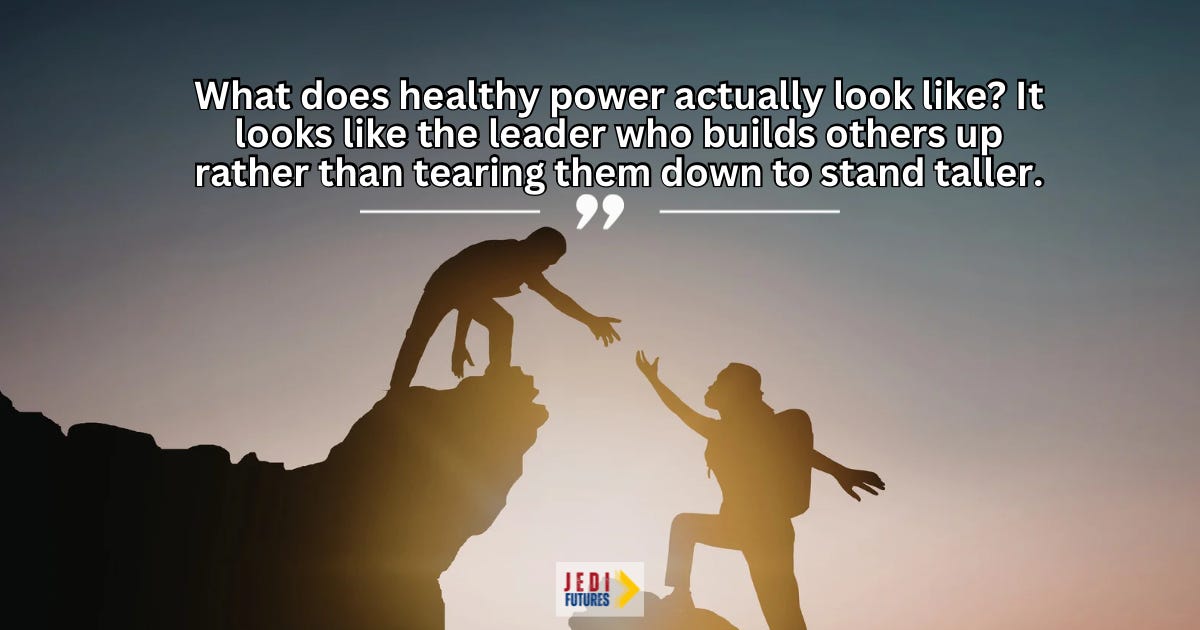
What does healthy power actually look like? It looks like the leader who builds others up rather than tearing them down to stand taller. The executive who creates accountability for themselves alongside their team. The partner who hears “no” and respects it. The politician who measures success by how many people flourish, not how many fear them. Philosopher bell hooks called it a love ethic: the idea that genuine power affirms the freedom of others rather than constraining it. Domination and love, she argued, are structurally incompatible. You cannot truly hold power over someone and genuinely care about their freedom at the same time.
This is not soft thinking. It is the hardest thing there is.
Parents who successfully raise healthy adults know this. The domination paradigm persists not because the dominators are too powerful to stop, but because we have not yet decided — collectively, and each of us privately — that we are willing to be liberated and therefore accountable to others. Choosing freedom is a decision that happens before we reach the ballot box. It happens in how we raise children, in which behaviors we reward, and in what we refuse to tolerate in our workplaces, our relationships, our communities. It happens when I put down the popcorn, take a breath, and remember that I have the power to choose for myself. My partner will have to manage his own response when I hold my “no” in a loving way.
The hard work of healthy democracy cannot be given to others to do. It will take each of us doing our part — inside our relationships, workplaces, faith centers, and communities — to uphold liberty for us all.