

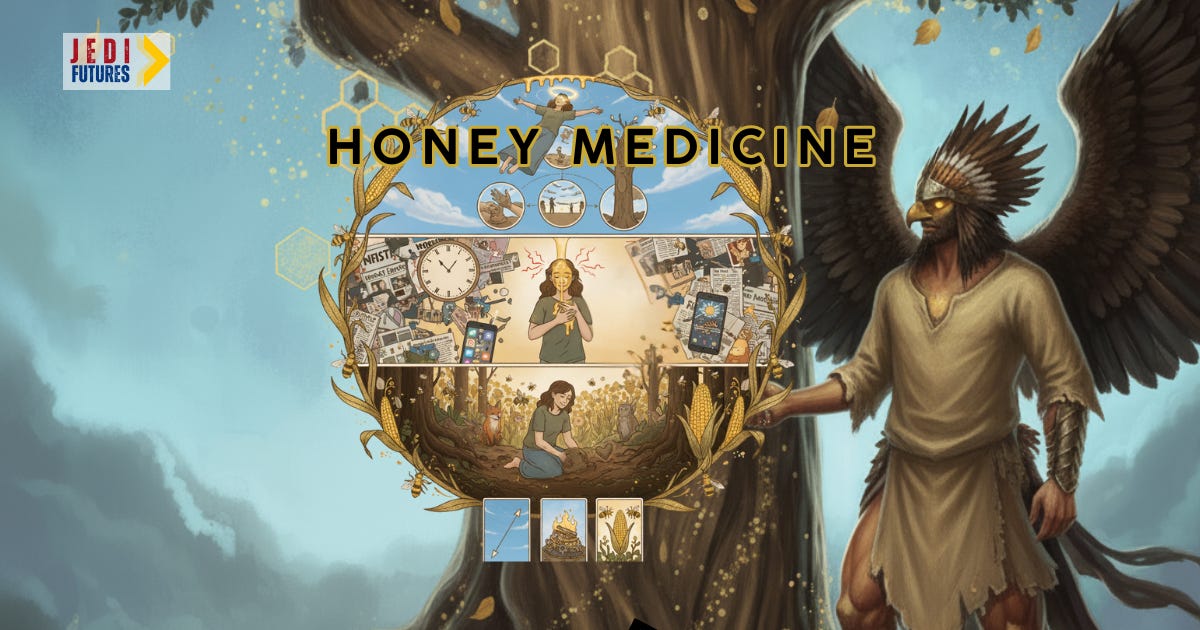
As the Seeker begins this journey, three cards are drawn for inspiration. They are The Arrow, The Sacrifice, The Corn.
The Seeker reaches the high plain at first light, wind combing the grasses into long silver lanes. The guardian tree holds its shadow like a bowl. Eagle Man Guide waits there, feathers dark against the trunk, and beside him stands Merrilyn—green-soft and river-strong, a presence that seems to lean toward suffering the way plants lean toward the sun. When the Seeker presses a palm to the bark, the tree opens; they step through, and the world folds. One self slides downward into loam and root and hush. Another keeps walking forward into streets and headlines and ringing phones. A third rises as if lifted by warm air, finding the wide blue above.
In the middle world, sound arrives in shards—sirens far off, a clock that ticks too loud, a feed that never ends. The Seeker’s heart races and chest tightens as if laced. Panic sparks along familiar wiring; some of it carries the metallic taste of real danger, but much of it feels stamped and sold, a market of alarms. Pressure gathers between the brows, the sixth chakra knocking like a bird against a window. Insights rarely arrive in the midst of alarms and danger. Merrilyn doesn’t speak at first. She simply raises a hand and breathes, and the Seeker follows until the breath lengthens and the ribs remember how to expand. When the third exhale finally empties, a light the color of old honey pools through the skull—thick, slow, irresistible. It doesn’t pour so much as settle, lining the inner surfaces with warmth. With the panic fading, the Seeker remembers a story of the dead wrapped in honey for their journey, preserved not against change but for it. The body unclenches, as if every small hinge has been quietly oiled. “I’ve let fear drive,” the Seeker admits, voice low, and the admission lands like a key turning.
Below, the underworld forest breathes with its own night. At the edge of a clearing, woodland creatures flicker in and out, innocent sentries from a softer script. They nose the leaves and listen for nothing in particular, as if by refusing to look toward the road, they can convince themselves that change will not arrive. Content to dwell here for a moment, the Seeker kneels where the ground turns to honest mud—water and clay and whatever the last fire left behind. Hands enter without a plan. The first touch is cool and shocking, the second familiar, the third playful. Forms appear and collapse: a bowl that becomes a river stone, a river stone that becomes a small, rough heart. The joy is not in the keeping but in the shaping, in the slide of palm against earth, in the way the mud records and then forgets. Making without mandate loosens something that all the urgency had cinched tight. There is a brief wish to save a perfect curve; then it passes, and the curve returns to swirl.
In the midst of this creative stream, a hum arises as a thought and becomes a flower-filled field. Bees gather out of the light itself, small bodies dusted in gold, legs furred with purpose. They drift from bloom to bloom in a rhythm older than clocks—touch, lift, leave, return—each visit both gift and theft, a grain carried, a grain given back. They do not try to be useful. They are useful because they are true to their being. Around them, corn ripens with a quiet pride; fruit swells into its own weight. Watching, the Seeker feels how the age has overvalued proof and output, how the ledger stole attention from the well. When being is centered—right place, right relation, right pace—production follows the way apples follow spring. “When I choose being,” the Seeker says, not to anyone in particular, “the work ripens on its own.”
Higher still, the upper world opens like a window thrown wide after rain. The air is but a clean breath here. From this height, the Seeker glimpses three versions of a single life. In the underworld: mud on forearms, laughter unhooked from results, beginnings shaped and gladly lost. In the middle world: a circle of people under open sky, heads bent together in the ordinary intimacy of problem-solving, fear present but not enthroned. In the upper world: a witness who does not flinch, who lets insight arrive in its own weather and does not chase it with nets. The view is not born of superiority; it is spaciousness, the difference between being inside the storm and watching its edges.
“Is there more?” the Seeker asks, and Merrilyn steps close and they embrace. It is a simple bringing-together, a joining at the sternum, a warmth that spreads outward in even rings. The third eye hums as if a small sun has taken up residence there—no glare, only steady radiance. Merrilyn’s compassion has the character of water: it moves toward the lowest places without judgment, it carries what is heavy without keeping it, it teaches everything it touches to soften around its own shape. Eagle Man Guide stands just over the Seeker’s shoulder, a watch kept without words.
When the three selves fold back into one body beside the tree, the high plain has shifted almost imperceptibly—the grasses now a shade greener, the wind a little less insistent. The cards feel different in the hand. The Arrow no longer points at the loudest fear but toward the quietly true—signals that hold when the volume drops. The Sacrifice asks not for blood but for a laying down of compulsions: the grind for its own sake, the constant reaching for proof. The Corn—ordinary miracle—reminds the Seeker that the harvest is a choir, never a solo, and that abundance is what happens when many kinds of beings keep faith with their nature.
The Seeker does not make a speech. Instead, there is a small vow, simple enough to remember when the street noise returns: “I will aim my attention. I will practice presence. I will let the harvest come.” Merrilyn’s smile is not approval so much as acknowledgement—as if a gate has been swung open and the path beyond it is well worn, waiting. Eagle Man dips his head once. The plain lifts its long breath. Somewhere, beneath the surface, bees go on with their unremarkable, saving work.