

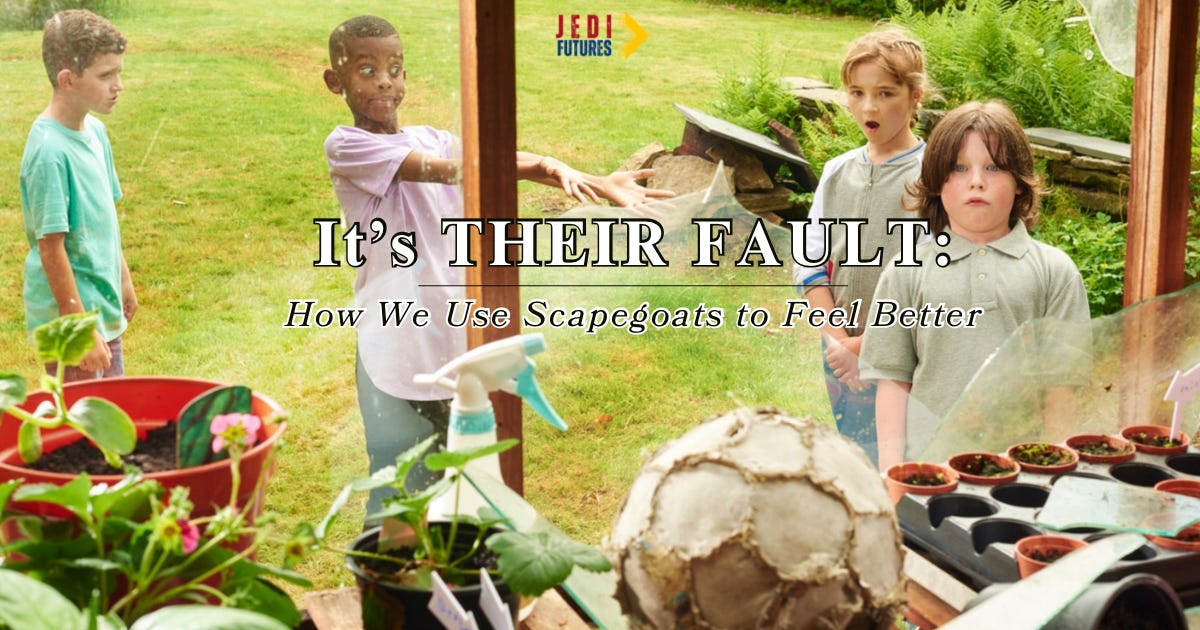
When life feels hard to explain, scapegoats make it feel easier.
A scapegoat is a person or group blamed for problems they did not solely cause—or did not cause at all—so the rest of us do not have to sit with complexity, uncertainty, or our own responsibility. It’s like when the cat knocks something off the counter and then looks at the dog as if to say, “the dog did it.” We use scapegoating to turn a tangled mess into a simple story. Something is wrong. Someone must be at fault. We look around - and find “them.”
People who desire power know when we are scared, overwhelmed, or disoriented, our minds look for clarity. We want to know who caused the pain. We want a villain we can point to. We want relief from the discomfort of not knowing, or from the harder truth that many problems are structural, shared, and slow-moving. Solutions are difficult to enact. A scapegoat is easier to find.
It is our old human habit to pile our fears, anger and uncertainty onto something we can see outside of ourselves. When we blame someone, it gives us the illusion of control over our own lives. Or over the chaos that accompanies change.
I’ve done it in my own life. When leaving a position once, it would have been easy to blame my supervisor or the lack of funding. That version of the story would have directed my fear and anger about financial instability away from my own choice to leave. But the truth was more layered than that. I had outgrown the role. I was bored. I was unhappy. I needed change. And after the change happened, life was chaotic for a while until a new normal emerged. Scapegoating would have made the story cleaner, but it would not have made it truer.
That is why scapegoating is so politically useful. A leader, a movement, or an institution can take a public fear (like AI job losses, unaffordable housing & healthcare) and direct it toward a target. Not upward toward power. Not inward toward self-examination. Not outward toward reforming broken systems. Sideways. Downward. Toward someone more vulnerable, more visible, or more easily cast as “other.”
Once that happens, the script writes itself. “They” are the reason jobs are scarce or the neighborhood is changing. “They” fill emergency rooms for non-emergency use or compete for affordable housing. “They” are why the country is in decline. Of course, “They” are “Us,” too. We are blaming our neighbors for system failures instead of holding our elected leaders accountable.
It’s like blaming the person crammed into the center seat for your discomfort instead of the airline for putting too many rows of seats, too close together for a comfortable flight. A better seating design for passengers would solve the discomfort. Shouldn’t we be angry at the gate agents and flight attendants for treating us like sheep, too?
Do you know what unifies people most quickly? A common enemy. It redirects anger away from those with actual power. It gives frightened people a feeling of moral righteousness. And it allows leaders to present themselves as protectors, warriors, or truth-tellers simply by naming an enemy and promising punishment. Scapegoating works for us because it simplifies reality. Leaders use scapegoating to organize power.
History gives us more examples than we should need. In Nazi Germany, Jews were blamed for economic pain, social decay, and national humiliation. Antisemitism already existed (as it had for millenia), but the Nazi regime weaponized it, turning old prejudice into state doctrine. The point was not only hatred. It was also a consolidation of power. Once the public accepted the lie that Jews were the source of Germany’s suffering, extreme control and cruelty could be sold as defense.
The United States has done its own version many times. Chinese immigrants were blamed for labor problems in the 19th century. Japanese Americans were treated as collective threats after Pearl Harbor. Immigrants of all kinds have periodically been cast as the reason ordinary Americans are struggling, as though wage stagnation, housing shortages, corruption, or weakened institutions could be pinned on the nearest outsider. The focus on ICE raids and patrols in American cities is an ongoing example of scapegoating immigrants writ large, with the lie that “violent criminals” are being sought. Evidence does not bear out the claim.
And of course scapegoating does not only happen through race or nationality. Women have been scapegoated for social change. Poor people for economic dysfunction. LGBTQ people for moral decline. Intellectuals for cultural drift. Rural people for backwardness. Urban people for corruption. Depending on the moment, almost anyone can be turned into the explanation for what hurts.
That is one reason scapegoating is so dangerous. It is flexible. It adapts to the anxieties of the time. Beneath all its changing forms, the mechanism stays the same: find the fear, find the target, repeat the story, gain the power.
There is also something more personal at work here, something harder to admit. Scapegoating is not only something bad leaders do to the public. It is something human beings do in families, workplaces, friendships, and communities. We often feel better when pain can be located in one person. The difficult child. The troublesome employee. The unstable neighbor. The relative who “ruins everything.” Sometimes a whole group learns to dump its tension onto one body and call that justice.
That does not mean the person being scapegoated is never difficult. It means the blame usually carries more weight than one person could possibly deserve. In an unhealthy dynamic, the scapegoat serves a social function to hold the feelings the rest of the group does not know how to process. It is convenient and it is unfair.
That is why confronting scapegoating requires more than correcting facts. Facts matter, but they are often not enough. The appeal of scapegoating is emotional before it is intellectual. It offers clarity, belonging, innocence, and direction. It tells us that we are not implicated. That someone else is contaminating the whole. That if we remove them, life will make sense again.
Of course, life doesn’t work that way. Scapegoating may create temporary unity, but it does not create truth. It may focus anger, but it does not solve underlying problems. It may win elections, drive clicks, fill prisons, or justify crackdowns. But it leaves the deeper causes untouched. In fact, it usually protects them. That is the cruel genius of scapegoating. It makes people feel powerful while keeping the real sources of power undisturbed.
So what do we do?
We start by getting more honest about our own hunger for simple blame. I have friends who began noting “Make-wrong” as shorthand to point out the unconscious blaming.
We ask harder questions when a story arrives fully formed with a villain already attached. We can check facts before sharing the meme we want to believe.
We notice when public anger is being directed toward people with less power rather than those making decisions. What comes to mind here?
We ask who benefits when the public is busy hating sideways.
And we practice tolerating complexity, even when it isn’t comfortable.
That may be the most countercultural act available to us right now.
Most problems are multi-faceted, not simple. If they were simple, we would have solved them. Social change can offer benefits and losses, look for the benefits. New and unfamiliar people can be met with curiosity instead of suspicion. If we want a healthier society, we have to resist the seduction of “It’s their fault.”
Are you old enough to remember the Red Scare or McCarthyism? It happened 1950-54, when the prevailing paranoia in society was being accused of being a communist. McCarthy rode to power on his scapegoating of anyone who did not capitulate to his view. It is a lesson that runs deep in our nation.
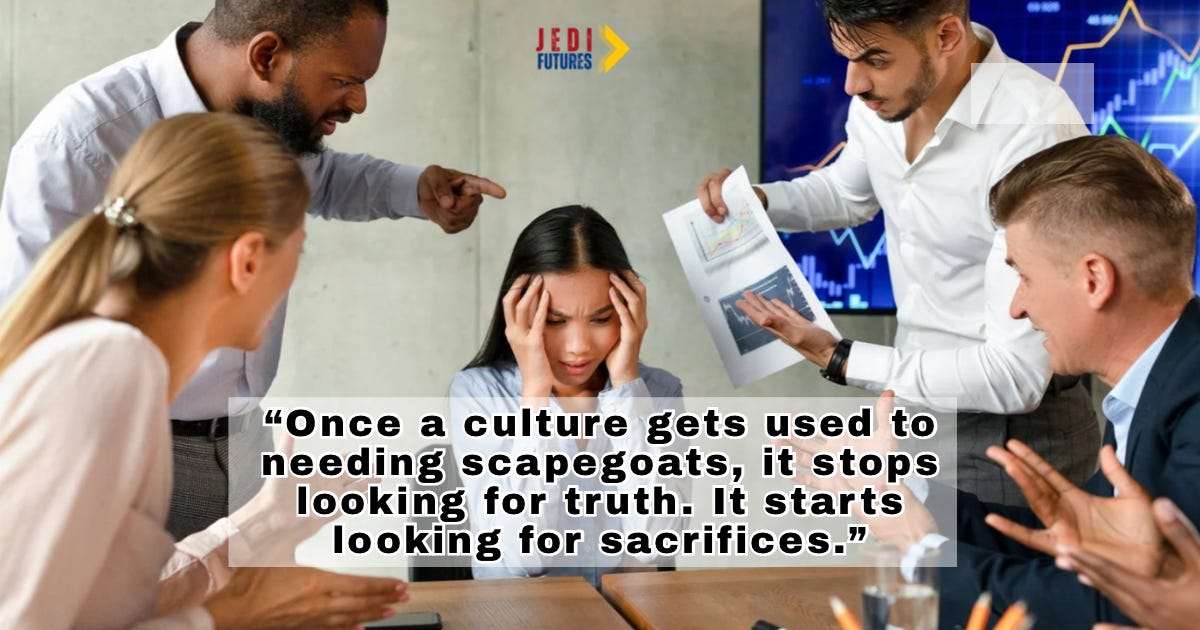
Once a culture gets used to needing scapegoats, it stops looking for truth. It starts looking for sacrifices. Sooner or later, everyone becomes vulnerable to the fire.
Let’s commit to truth and neighborliness so we can thrive together. It’s a better future, by far.