

“Life finds a way.”
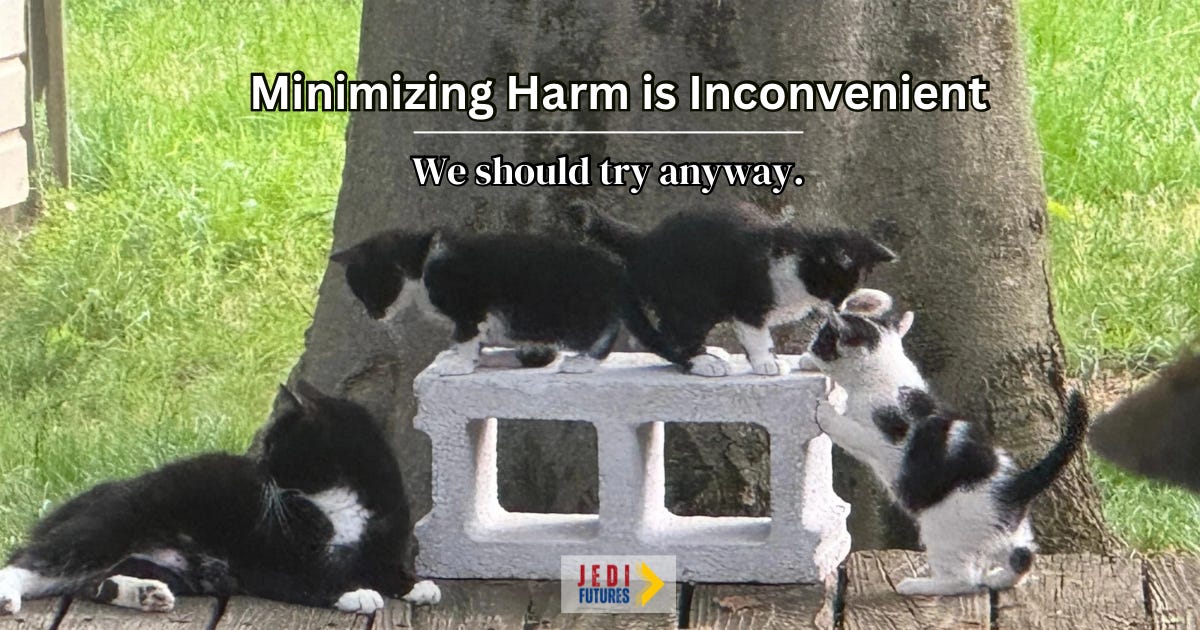
These words ring in my heart as I manage my own despair at the state of our nation and the world. When I want to curl into bed, I find myself instead seeking small joys—like the feral Mama Kitty who delivered three beautiful kittens to our care.
OK, maybe she didn’t mean for us to care for them, but offering her free food helped her care for them. This small act of kindness—feeding a nursing pregnant cat—is part of how life finds a way. It reminded me of my own sense of connection, my caring, and my dedication to kindness. My goal was less about “rescue” and more about finding solutions that met the needs of her family and our family. How could we do so while minimizing harm or trauma for us all?
Caring for these creatures was not without cost or inconvenience. The dogs lost access to their backyard for 17 days, because that’s where Mama Kitty and the kittens had moved in. This meant I had to make sure the dogs got enough exercise via the dog park and walks. My indoor cats received less attention than normal, as I spent time outside socializing the kittens to human touch. Mama Kitty wasn’t so trusting.
The extra care wasn’t sustainable for me. We needed a plan to minimize harm and offer the best outcomes for us all. Dogs need space to roam. Kittens need safety and Mama Kitty. I need a more normal routine that doesn’t stress me out every day.
Here are the highlights of the plan:
Move Mama Kitty and the kittens indoors, separated from current pets.
Continue socializing the kittens, and Mama Kitty if possible.
Find foster homes for the kittens.
Allow the dogs back in the yard.
Have Mama Kitty spayed.
Keep one of the kittens.
When it came time to move them indoors, I waited until Mama Kitty was away hunting, then swept the kittens into a crate and moved them into a small room in the house. It was a small breach of the tentative trust. The distance was less than 10 feet from where they’d been, but a world of difference in atmosphere. We left a window open for Mama Kitty, hoping she would join them. About 24 hours later, she did, following their cries and the smell of food. I closed the window, feeling her panic and sense of betrayal land on me. The plan was underway.
So the little family was reunited, the dogs had their yard back, and we transitioned to the next action step in our minimal-harm plan: provide regular food, a quiet room, and a cat box—which they thankfully used. Whew! The hours I’d spent outside socializing continued in the small room. The next step in the plan would be traumatic, so we were building resilience with them to weather it more easily. Our neighbor brought friends to meet the little ones, and they chose to foster the two kittens who needed a home.
Of course, Mama Kitty needed to be spayed, so she could live her best life and we didn’t have to worry about new kittens. We had a foster home lined up for her—if she wanted to become friendly to humans. A week inside had not convinced her that humans could be trusted. On the day of her surgery, we swept her into a trap borrowed from the local shelter and delivered her to the low-cost clinic. We picked her up that afternoon and returned her to the small room. Only one of her three kittens remained; two had been placed in a new home the previous night.
The dogs were frantically overjoyed at their return to their yard, sniffing all that had happened while it had been “off-limits” to the likes of them. We had slipped up once, causing a fight between Mama Kitty and Lady Bird. It was a setback from which Mama Kitty would not recover; she would not trust humans again. The entire time she was inside, she hid behind boxes in the small room, growling and hissing when we approached her. I can’t say that I blame her.
After three days of rest and food, I moved the last kitten into a crate in the main part of the house and left the window open again. Several hours later, after dark, I brought the kitten back to the small room and caught sight of Mama Kitty outside the window. She mewed to her offspring, who mewed in return. I cried as I closed the window. I knew it was the least harmful thing to do, but it wasn’t harmless.
Given that I’m classifying this as a political essay, you may wonder what this has to do with politics. I’m glad you’re wondering.
In politics, we wrestle with how to manage collective well-being—and decide who absorbs the cost of caring for the vulnerable. In our household, the cost fell on those of us who had more to spare: the dogs gave up the yard, my indoor cats got less attention, I lost sleep. That seemed right. The kittens and Mama Kitty had less; we had more.
Our current politics has been corrupted to invert that arrangement. The cost is pushed downward, onto people who already have the least to spare, while the needs of billionaires and corporate oligarchs are treated as urgent. The people in need are seemingly disposable. Instead of stopping to consider the whole system of how we are interconnected, we prioritize efficiency and production over the thriving of life itself.
I keep returning to something I learned from those weeks: the least harmful path is not harmless. Honest care work names its costs instead of pretending good choices are costless. Cruelty thrives on the opposite—the lie that there are easy answers, that someone else’s suffering is just the price of efficiency. Real governance, like real caretaking, looks at what it cost and tells the truth.
And here is the part I want to insist on: life found a way through community, not through anyone with power or wealth. My neighbor showed up. A foster home appeared. Strangers absorbed inconvenience for the sake of small creatures who could never repay them. That is the counter-image to oligarchy, and it is closer than the headlines suggest. It lives on every block where someone is quietly choosing the harder, more generous path.
When systems get out of balance, they implode. And then, life finds a way. It is happening before our eyes. How will you choose to respond?
I choose kindness.