

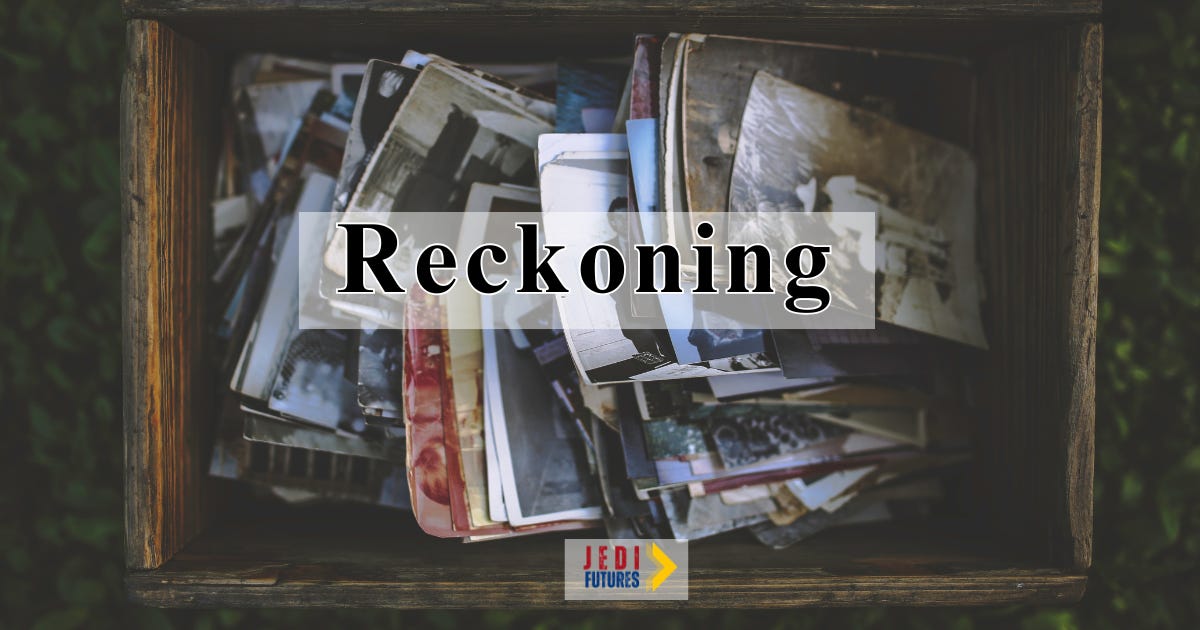
The past few days I’ve been sorting through my grandmother’s collection of photographs. She was prolific in this sense — I don’t remember a childhood moment when she didn’t have her camera in hand. Except maybe when we were baking cookies. Even then, there is visual evidence of me as a toddler at her counter.
She passed from our lives about twelve years ago, but had lived 10+ years in various assisted living situations until Alzheimer’s left her a shell of her former self. It was a long goodbye, where my mother took on the burden of caring for her mother. My grandmother had groomed me, for as long as I can remember, to be her caregiver as she aged. Her own mother had ended up in a sanitarium after being found wandering the roads in rural Kansas, unable to find her way home. All the kids had died or moved away from that hard life, having survived the Great Depression and the Dust Bowl. It was my grandmother’s greatest fear — ending up in a mental institution. As my mom grew up, she had claimed that her mother, my great-grandmother, was dead. Imagine my mother’s surprise when they went to visit when she was about ten.
The sheer scale of my grandmother’s photograph collection is daunting. We — my mother and I — sorted through five large boxes in three days. Then we took a peek into the larger trunks. Of the five trunks, two contain loose photos, one contains photos in frames. The remaining two hold years of genealogy research and correspondence. Some of the collection was preserved from her younger sister as well, so there are copies — copies of copies of copies. This was one of my grandmother’s coping mechanisms as she aged. She would forget where things were, so she kept multiples of everything, stored in various places.
On another visit, there will be more sorting ahead of us. I’ll bring the sorting system and the discipline to resist wandering down memory lane, so we don’t get lost. Even still, occasionally, bad memories will surface as we sort the photographs. In this initial pass, it was easy to toss those photos, and those feelings, in the trash.
But tossing away pictures of people who hurt us doesn’t remove the pain.
To heal, we need to reckon with it — to find, or restore, a sense of wholeness within ourselves. Therapy can help. So can apologies, demonstrated remorse, and changed behavior. Even when people are already dead. Every family has wounds that are unique to their family. And we are only beginning to see the wounds in those around us.
Zoom out for a moment. Consider how your ancestors may have harmed, or been harmed. Think of your own forefathers and foremothers. What did they endure? What did they do so that you could be here?
Nearly all of our ancestors were pioneers or immigrants in the United States. Unless one is full-blooded indigenous to the tribes of North America, someone in our lineage left their previous life behind and came here — or was forced to come here. Everyone of us.
Consider the people in those family photographs you might want to throw away. Beyond causing harm, they were someone’s child. They were also shaped by fear — fear of scarcity, of loss, of becoming irrelevant, of being left behind. The harm they caused often grew in the soil of their own unprocessed wounds.
This doesn’t absolve them of their actions. But it does explain them.
The settlers who displaced indigenous peoples were often themselves displaced — from England or the Netherlands for their religion, from Ireland during famine, from Germany during war, from Eastern Europe during pogrom. They arrived desperate, carrying their own grief and terror, and were handed a story: there is land here, and it can be yours. They grabbed it. They told themselves a new story to justify the grabbing. My Kansas ancestors were given that land in this way from the US Government, since Virginia was already “taken.”
The architects of slavery built an entire civilization on the premise that their own economic survival required the dehumanization of others. They were protecting their privileged way of life — which is to say, they feared losing it and having to reckon with what they’d done to hold it.
When people resist reckoning, it is rarely due to pride. It is more often their identity. To admit that your foundation was built on harm is to feel a shame you didn’t ask for and didn’t earn. And underneath that shame is the harder question: who are you without the story? So our denial about what our ancestors did to survive, what our nation did to be born, runs deeply within us. It wasn’t all daisies and sunshine, as the writers of history would like us to believe.
Facing the truth of our nation, that is the real work — for individuals, and for us collectively.
We are in a season of reckoning, whether we chose it or not. The national trunks have been opened to expose the harm of indigenous genocide, of slavery, of racial concentration camps. The photographs are spread across the floor for everyone to see.
Will we dare to look? To reckon with our past?
Some of us have been waiting for this — have needed this — for a very long time. Others feel ambushed by it. Like being handed a box of photographs you didn’t know existed, of people you weren’t prepared to see again — you’d thrown it away to forget. And what happens when we feel ambushed? We hunker down. For those of us who need to reckon and are ready, how do we make it safer for anyone to look?
It means letting people arrive on their own timeline. Reckoning is not a performance of the correct opinions — it is a process. It’s why “woke” received such intense backlash. My grandmother never confronted her family’s buried history. Still, she spent decades preserving those stories so we could. It also means separating identity from complicity: you can love this place and still grieve what was done in its name. In fact, that love is exactly why this matters. And it means offering a vision of what’s on the other side. Reckoning without repair is just punishment. What does wholeness look like for a nation? What do we gain — all of us — when we finally tell the truth?
The goal is not to make people comfortable with avoiding the hard things. It is to make the hard things survivable enough to walk toward.
The trunks are open. The photographs are waiting.
It’s time to look.
This is such an important part of our way forward - individually and collectively. Last summer I took a dive into 'Becoming a Good Relative: Calling White Settlers Toward Truth, Healing, and Repair' by Hilary Giovale which speaks deeply into just what you've addressed: among our ancestors are both the oppressor and the oppressed. And on some level whether we've heard the stories are not we carry those cellular memories. Thank YOU for opening this conversation!