

What are our leaders actually committed to? Don’t listen to the soundbites. Watch the results they pursue. Look at what they build — and what they let burn.
I could have written today about election results, about primaries and the horse race of it all. Honestly, I couldn’t stomach it. Not another angle on a toxic political process where we swing at soundbites like they’re piñatas, while no one has thought to ask what prize they want inside. We fight over the present tense without a shared vision of the future.
Committed leadership begins with vision. Then comes a plan — not rigid or carved in marble, but supple enough to move around the unpredictable currents of the world. Committed leadership can move beyond the noise of the moment and work around crises no one saw coming. Committed leadership can think and plan beyond the algorithms and propaganda to land in our hearts as truth.
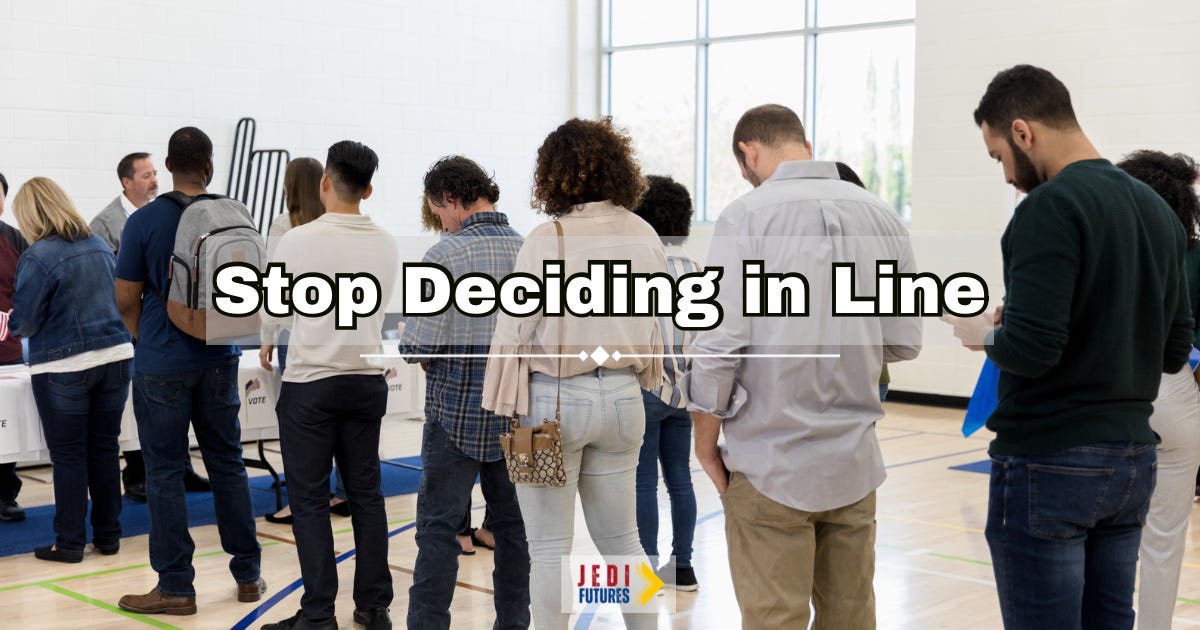
I heard a man interviewed yesterday who was changing his mind about who to vote for while he stood in line to vote. It was like gambling — placing a bet on whoever might make the conditions of our lives marginally less miserable by Tuesday. He said homelessness was out of control. He was holding the mayoral candidate responsible. And you could understand the impulse, even as it missed the mark by a mile.
Homelessness has been growing in cities for decades — not because of any one mayor, any one policy, any one bad decision made in a city council meeting on a rainy Tuesday in March. It’s the long shadow of a system that chose profit and property rights over living wages and the right to a roof. The people sleeping on the street are visible; the system that put them there is not. So we blame what we can see.
Consider two examples of what leadership commitment looks like in practice.
The Heritage Foundation spent decades — and millions, possibly billions — building a pipeline of conservative thinkers, lawyers, and policy architects. Their goal was to cement conservative values into American governance for fifty years or more. You can disagree with everything they stand for and still recognize that for what it is: vision, resources, and the willingness to work across a time horizon that most politicians can’t even see from where they’re standing.
Go back further, to the 1930s. The New Deal was a wager on a different kind of America — one where the government wrested control from concentrated business interests and built something. The New Deal was based on a belief in the dignity of work. People went to work. They built roads that still carry us somewhere. The workers built dams that still hold back the water (environmental concerns were not yet in our minds). They created parks that still shelter the kind of afternoon that makes you believe, briefly, in the country you live in. That’s commitment worn into the landscape itself. Built by us, the citizens, for us.
Both of these visions required someone willing to ask the largest possible question: what kind of society do we want to live in? And then to spend years — decades — making the answer real. Each was driven by a belief about who mattered, and whose version of “better” should win. If only we all wanted the same things.
As it turns out, most of us do.
I know this because I spent time doing the research. Across cultures, income levels, generations, geography, and across the divides we’re told are uncrossable, there are three and a half things that everyone wants when they imagine the life they’d like to be living. I’d bet you want them too. Here’s the research tool — worth a few minutes to ponder before you read on.
The first is a deep connection to others. When people describe the future they want, they almost always describe some form of belonging — relationships where they can be fully themselves and feel genuinely accepted. This is not a nicety. It is wired into us as surely as hunger.
The second is community. Not only neighbors who wave, but a place where connection is nurtured, where the things you need every day — food, friends, transportation, a place to laugh, a place to rest — are woven into the fabric of where you live. It is accessible, human-scaled and feels aligned with life itself.
The third is contribution. People want to give something of themselves to those around them. It might look like hosting dinner for the block, or painting a mural on a wall that used to be blank, or fixing the fence for the elderly couple next door, or showing up at the shelter on Saturday mornings. The desire to offer what we have — to be useful to people nearby — turns out to be nearly universal.
And then there’s the half. Not everyone spoke about it, but those who did were unambiguous: nature is part of their life. It could be a park in the middle of the city or accessible trails nearby. It may be a bubbling creek one can hear walking the dog. You know, a reminder of life even if you rarely see it. A few people wanted to live at the edge of wilderness, inside a small tight community, close enough to people to feel human and close enough to the wild to feel sane. Nature was not decorative in their visions, it was foundational.
Of course — we are nature. The boundary we’ve drawn between ourselves and the living world is a story we tell, not a fact we inhabit.
So here is the question I wish we put to every candidate, at every level, in every race: what kind of system — from city block to federal policy — creates the conditions for deep connection, healthy accessible community, meaningful contribution, and a living relationship with the natural world?
That is the real question I long to hear answered. Not who’s up in the polls or who said about whom. The committed leaders of my vision are stewards of a system that supports a good life in harmony with nature.
Committed leadership is required to hold a vision large enough to matter. Flexible leadership is required to move toward that vision through the unpredictable weather of the actual world. We deserve both. We should demand both.
And maybe, while we’re at it, we should stop deciding in line — and start asking better questions. What is their vision? Does it align with our own?