

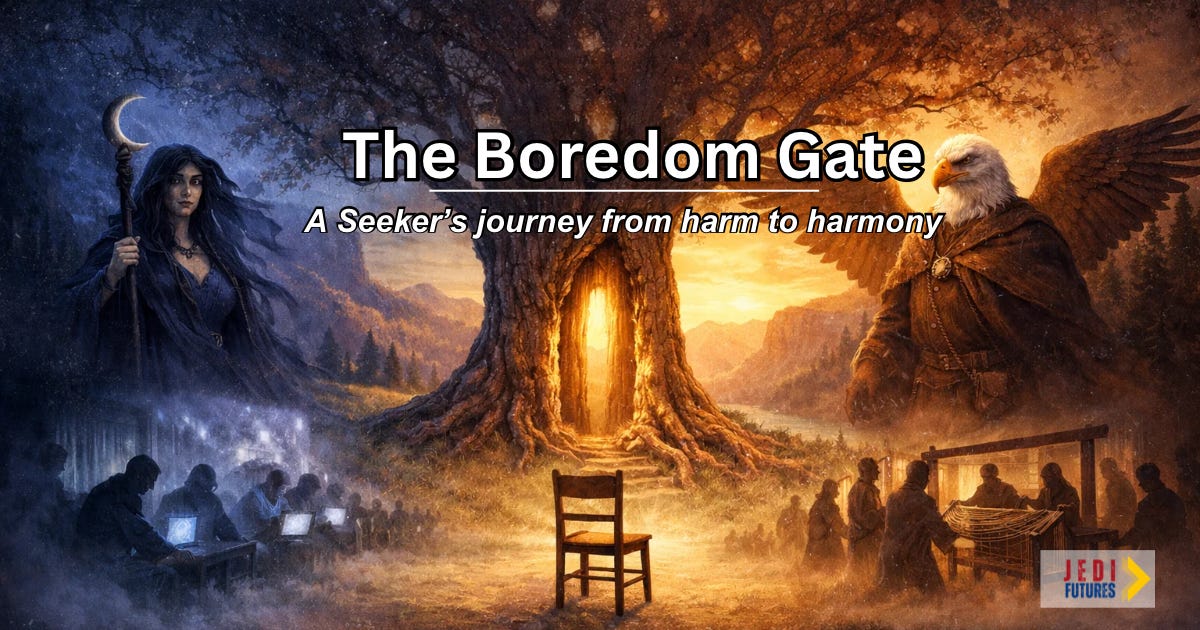
The Seeker arrived at the tree restless and irritated. Not dramatically so. Not in a way that would make a good story. Just an ordinary human restless. It was the kind of discomfort that made her reach for her phone without knowing why. The kind that made silence feel like a problem to solve. The kind that turned every empty moment into a small emergency.
She stood on the high plain above the canyon, where the wind moved through the dry grasses and the river far below carried sunlight on its back. The tree waited on the bluff, older, wiser and patient as stone. Its roots curled into the earth like fingers holding the world together.
Eagle Man Guide had arrived first, listening to her arrive long before she appeared. “You are late,” he said.
“I was distracted,” the Seeker replied.
“That is one way to say it.”
She sighed. She was not in the mood for riddles. “I don’t want a journey today,” she said.
“Of course not,” he replied. “You want to be entertained.” That irritated her because it was true.
Not in a shallow way, exactly. She did not think of herself as someone who needed constant distraction. She read. She reflected. She cared about the world. She followed events because events mattered. She watched, listened, scanned, refreshed, reacted, grieved, raged, hoped, and despaired with what felt like a citizen’s responsibility. Still, the phone was always nearby. There was interesting food to sooth her anxiety. The world always had another alarm to offer.
“I pay attention,” she said.
“No,” Eagle Man Guide said. “Your attention is being taken.”
Before she could argue, he pressed one feathered wingtip against the trunk of the tree. A seam appeared in the bark, widening into a dark doorway. The tree breathed open.
The Seeker knew this threshold. She had passed through it many times. Still, she hesitated.
“What is below today?”
“The place you keep avoiding.”
“That could be several places.”
“Yes,” he said. “But today we begin with the smallest one.”
They stepped through, into the passageway that led downward. Where there was normally a hum of the forest, today it was quiet. Too quiet. The Seeker felt herself grow uncomfortable almost immediately. Her mind reached for something to do. A thought. A task. A memory. A problem to solve. Anything. The silence pressed around her like a smothering cloak.
“How long is this tunnel?” she asked.
“As long as you need it to be.”
“That is not helpful.”
“It rarely is.”
The Seeker kept walking. After a while, the roots opened into a clearing she had never seen before. It was enormous, surrounded by sentinel trees and otherwise almost empty. Only a single plain wooden chair sat at its center.
The Seeker stared at it.
“That’s it?”
“That is it.”
“I came all this way for a chair?”
“You came all this way because you cannot sit in one.”
The Seeker folded her arms, growing sullen.
Eagle Man Guide gestured toward the chair. “Sit.”
She sat.
At first, nothing happened. Then more of the nothing kept happening. The Seeker shifted. She listened for guidance. She searched the trees for symbols. She studied the ground for something that might become a trail or a map. She tried to meditate. She tried to make sense or meaning. She tried to be spiritually impressive. There was nothing.
Only the chair, the ground and the silence. After a while, she became bored. Not peaceful. Not enlightened. Bored.
“If you are bored, it means your a boring person,” came a thought she quickly dismissed.
Her thoughts began to scratch at the inside of her skull. She thought of emails unanswered. News unread. Arguments unfolding without her. People being wrong somewhere on the internet. Shows she could watch. Articles she could skim. Problems she could worry over. People she could mentally correct. Causes she could care about from a distance.
The silence remained uninteresting. Finally, she snapped, “What am I supposed to do?”
Eagle Man Guide stood at the edge of the chamber. “Notice what happens when no one is entertaining you.”
“I hate this.”
“Yes.”
“My mind is everywhere.”
“Yes.”
“I keep wanting to leave.”
“Yes.”
“Are you just going to keep saying yes?”
“Yes.”
She glared at him.
Then another voice came from the darkness. “Most humans mistake discomfort for danger.”
Hecate stepped from a shadowed archway, her indigo-blue aura casting soft light across the stone. She carried no torch. She needed none. The darkness seemed to know her and make room.
The Seeker softened at the sight of her.
“I’m glad you’re here,” she said.
“I know,” Hecate replied. “You wanted rescue.”
The Seeker groaned. “Not you too.”
Hecate smiled gently and came to stand before her.
“Boredom is one of the oldest gates,” she said. “It does not glitter, so people walk past it. It does not flatter, so people distrust it. It does not entertain, so people call it useless.”
The Seeker looked around the empty clearing with its dirt and tall trees.
“It does feel useless.”
“Only because nothing is taking you away from yourself.”
At that, the clearing changed.
The trees shimmered, and images began appearing between them—currents of light and shadow. The Seeker saw ghosts of people hunched over glowing screens, their faces lit blue in dark rooms. She saw crowds roaring in arenas, slot machines flashing, televisions shouting, news banners crawling like insects across the bottom of every screen. She saw fingers scrolling, scrolling, scrolling. She saw anger moving from person to person like sparks in dry grass.
She was surrounded by ghosts. Then the images widened.
She saw rulers, advertisers, influencers, campaign strategists, and platform designers gathered around a vast invisible loom. Every thread was made of human attention. Every tug shifted a person’s gaze. Every knot became a habit. Every habit became a market. Every market became a cage. They were weaving people into cages of their attention, separated from each other.
The Seeker felt cold. “The world economy would like our attention,” she whispered.
“And the political class,” Eagle Man Guide said.
Hecate nodded. “Outrage is a powerful hook. Tribal loyalty is a profitable spell. Fear keeps citizens moving so quickly they forget to ask where they are being led.”
The Seeker watched the wall as a figure appeared in the weave—someone running from alarm to alarm, from argument to argument, from crisis to crisis. The figure carried a lantern but never turned it inward. The light was always pointed outward, searching for someone to blame, someone to fix, someone to defeat. The Seeker recognized the posture. She had worn it.
“We tell ourselves we are paying attention,” Hecate said. “Sometimes we are. But often we are abandoning the only place where transformation can begin.”
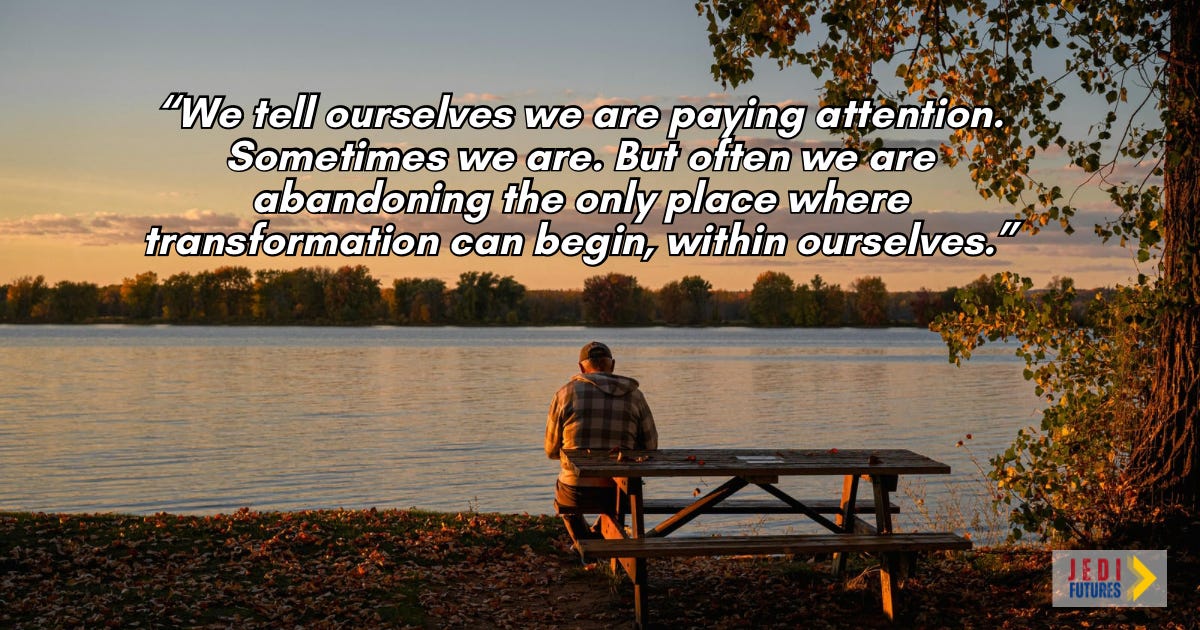
“My own life,” the Seeker said.
Hecate placed a hand over the Seeker’s heart. “Yes, your own life.”
The clearing shifted again. This time the Seeker saw shadows of a small room from years ago. She was younger, sitting across from a woman who came to her for coaching. The woman carried many troubles and named them carefully, week after week. Together, they had chosen small steps, simple practices, questions for introspection. And week after week, the woman returned without having done them.
The scene sharpened. The woman stood at the door after another session, hand on the knob, her face half-turned away. “I don’t find myself very interesting,” she revealed before she fled towards the comfort of her troubles.
The words echoed through the cavern with the force of a bell. The Seeker felt the old sadness return.
“I knew then I could not help her,” she said. “Not because she was hopeless. She wasn’t. But because she had no curiosity about herself. She kept trying to change people outside her, circumstances outside her, everything outside her. Her own life sat unattended.”
Hecate’s eyes were kind. “And did you think she is the only one?”
The Seeker did not answer. The empty chair beneath her suddenly felt less like punishment and more like invitation. Hecate turned toward the cavern wall. The images changed once more. Now the Seeker saw an abandoned house. Dust on the windows. Furniture covered in sheets. A cup left on a table long ago. A staircase disappearing into shadow.
“This is what happens when attention never comes home,” Hecate said.
The Seeker stood slowly. “Whose house is that?”
Hecate looked at her and the Seeker knew.
She walked toward the image, and the stone wall became a doorway. She stepped through into the house. Inside, the air was stale but not dead. Dust floated in the sunlight. Somewhere upstairs, a floorboard creaked. The house was not haunted by ghosts. It was haunted by neglect. On a small table by the window lay a bowl filled with glowing fragments. The Seeker picked one up. A memory.
Morning light through her own windows. Her chair. Her yard. The trees were holding still and moving at the same time. Birds arriving without announcement. The world was doing what it does without asking for her opinion. She picked up another fragment.
A quiet cup of coffee before the phone woke up. Another.
A walk without earbuds. Another.
A stretch of driving with no radio, no podcast, no incoming voice, just the hum of tires and the long ribbon of road.
The fragments warmed in her hand. “This is not boredom,” she said.
“No,” Hecate said from the doorway. “It is what boredom becomes when you stop fleeing it.”
“Spaciousness.”
“Yes.”
The house seemed to breathe with life.
The sheets lifted from the furniture. The windows cleared. The stale air moved toward the open door and disappeared. The Seeker heard water somewhere beneath the floorboards, a hidden stream traveling under the house, waiting for someone to listen.
Eagle Man Guide entered behind Hecate, filling the doorway with wings and shadow. “Harm thrives in reaction,” he said. “Reaction is fed by distraction, it feeds on projection and certainty. It is kept alive by blame, when our eyes search outward for enemies.”
“And harmony?” the Seeker asked.
“Harmony requires return,” Hecate said. “Return to the body. Return to the breath. Return to the inner house. Return to the question beneath all the noise: What is mine to tend?”
The Seeker walked from room to room.
In one room, she found old anger stacked like firewood. Some of it was useful. Some had once kept her warm. Some had become dry and dangerous. In another room, she found grief folded carefully in drawers. In another, fear paced in a circle, exhausted from keeping watch. In the kitchen, imagination sat at the table like an old friend, waiting with both hands wrapped around a mug of tea.
“You’re still here,” the Seeker said.
Imagination smiled. “Where else would I go?”
“I thought I lost you.”
“No,” Imagination said. “You outsourced me.”
The Seeker laughed, then almost cried.
Outside the house, the world still roared. She could hear it faintly beyond the windows: the feeds, the sirens, the opinions, the arguments, the endless demand to look away from the life directly in front of her.
But inside the house, something had changed. It’s not that everything was healed. Or harmonious.
Life itself had been reclaimed.
The Seeker returned to the main room, where Hecate and Eagle Man Guide waited.
“I understand why boredom matters,” she said. “It is not the goal. It is the gate.”
Eagle Man Guide nodded.
“Through boredom, attention comes home. Through attention, reflection returns,” Hecate said.
“Through reflection, imagination awakens,” said Eagle Man Guide.
“And through imagination,” the Seeker said slowly, “we can stop repeating harm by distraction or intent.”
The clearing dissolved and they were back beneath the trees, in the empty clearing with the wooden chair. But now the chair no longer looked lonely. It looked sturdy. Sacred, even. A plain altar to the unattended self. The Seeker sat once more.
This time, she did not ask what was supposed to happen. She let the silence gather. Her jaw loosened. Her shoulders dropped. Her breath deepened. The restless scratching in her mind quieted. She felt the nervous system, that faithful animal, realize it was not being chased. In the quiet, she saw the path from distraction and harm to harmony not as a grand staircase, but as a series of small returns.
She returned from outrage to breath, from distraction to presence.
She shifted from blame to responsibility and from entertainment to wonder.
She rejected the world that profits by scattering us and embraced the inner life that patiently waits to gather us again. After a while, Eagle Man Guide opened the passage back up through the tree.
The Seeker stepped out onto the high plain. The sun had lowered. The canyon glowed gold. The river below moved as it always had, carrying what it could carry, carving what it could carve, never hurrying and never stopping.
The Seeker thought of her own chair at home, the one by the window facing the yard. She thought of morning light with the trees swaying and full of bird. The generous boredom of looking long enough for the familiar to become alive again. “No need to entertain me,” she said softly.
Hecate smiled. “No,” she said. “You have your own attention now.”
Eagle Man Guide spread his wings, and for a moment the shadow of them passed over the Seeker like a blessing. “Where will you find boredom today?” he asked.
The Seeker looked out over the canyon. Not as a question to answer quickly or a task. She heard the invitation. And somewhere inside her, in the house she had almost forgotten, imagination opened a window to what comes next.