
When Waiting Is the Work
A lesson in patience, boundaries, and trusting the planted seeds

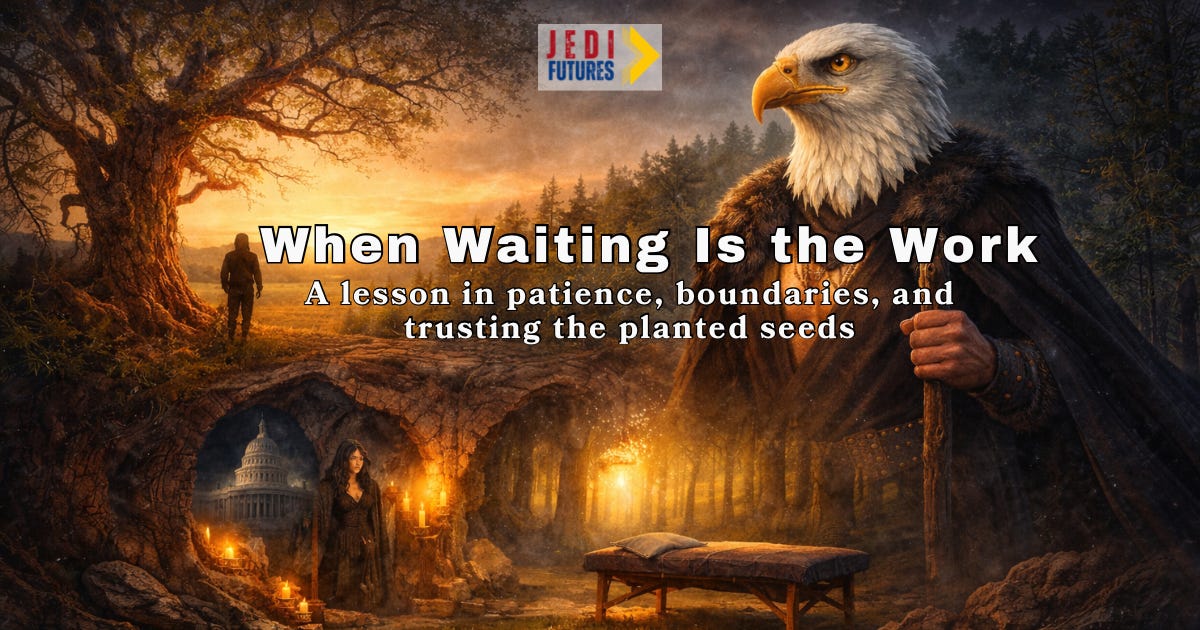
Dawn on the high plains arrives the way truth sometimes does—quietly at first, then all at once.
The Seeker stands before the old tree, breath visible in the cold air, when Eagle Man Guide appears as if he has been waiting there the whole time. No fanfare. Just presence. A nod that says: You’re on time. You’re still willing to learn more. Good.
Together they pass through the threshold and descend into the forest. The world changes immediately—darker, older, more alive. Yet the daybreak follows them down. Light threads itself between trunks and branches, turning the air into something you can almost drink.
Hecate is there, ready to enter the cavern beneath the Temple of Freedom, known as the US Capitol in the “awake” world. She greets the Seeker with an embrace that is both tender and exacting—like someone who can hold softness without letting anything slide.
“Come,” she says, and leads the Seeker inside.
The cavern opens—stone and hush and the feeling of being witnessed by forces that do not gossip, do not flatter, do not lie. A massage table waits in the center, plain and practical, as if holiness has no need for dramatic furniture. Hecate gestures.
“Face down,” she instructs.
The Seeker obeys.
Hands—some seen, some felt—begin to move around the body like wind through tall grass. Pressure here. Warmth there. A gentle insistence where the muscles have learned to brace. The work is intimate but not intrusive. The kind of care that doesn’t ask permission from the ego.
Chills sweep from head to toe as the Seeker exhales a long-held breath and finally—finally—lets go.
Not all at once. Not like a switch. More like a knot loosening under patient fingers.
As the work continues, what releases is not only tension, but the familiar aching beliefs underneath it:
Not enough.
Left out.
Useless.
Unappreciated.
The Seeker feels each story as it rises, like old paperwork pulled from a drawer—creased, dog-eared, stamped with emotions from another era. And as the unseen hands keep working, those stories begin to dissolve. Not erased. Just… no longer in charge.
A vulnerability follows—sharp and bright.
The Seeker feels the fear of being seen doing this—walking a spiritual path while also walking through the loud, cynical rooms of politics. The fear of what people might say. The fear of being misunderstood. The fear of being dismissed as ridiculous.
Hecate does not argue with the fear. She simply keeps her helpers working.
And then something surprising happens: the Seeker feels a downward pull.
Not the old weight that drags one down. This is different. This is weight like roots extending into the earth.
The body settles into the growing and rooting as if remembering it has permission to belong here. At the same time, something else lengthens—spine, breath, attention—stretching upward as if the Seeker has been a sapling bent by storms and is now allowed, again, to reach. The growing season approaches.
Grounded and growing.
Stone and sunlight.
The back pain eases. Alignment returns in quiet increments. The Seeker’s gratitude comes out as a whisper, then as a flood. Thank you. Thank you caring and nurturing.
The Seeker understands—not as an idea, but as a physical fact—that pain has been carrying a message: When there is misalignment… confusion… there is the strain of trying to stand in two worlds without a steady center.
When the work is complete, Hecate drapes an arm around the Seeker’s shoulders the way a mentor might, and guides the Seeker to a small loveseat tucked against the cavern wall—soft fabric, worn edges, the kind of place where hard truths can land gently.
The Seeker asks what comes next.
Hecate answers without drama.
“In the coming month or two or three,” she says, “your highest action for good is patience. Waiting. Seeds have been planted. That work is already done.”
The Seeker flinches internally—the old reflex that equates waiting with laziness, stillness with irrelevance.
Hecate continues, as if she can hear the thought without needing it spoken. “To the outside world, it may look like you’re sitting still. But inside, you have a garden to cultivate. Preparations to make.”
The Seeker nods. The words ring true in the chest, not the head.
Then the Seeker asks what challenges are most likely—and what is needed to address them.
Hecate’s gaze is steady. “The challenges will be internal. And they will involve your relationships with friends & family. You will be called upon to embody loving acceptance and loving boundaries. And to choose what serves that which you most desire.”
The Seeker feels the familiar surge of duty rise up—sharp, certain.
Inside, the Seeker’s first response is immediate: I’ve already chosen. I’m here to be of service to my family, friends, community and the world.
Hecate lets that land—and then tightens the focus.
“Be very clear,” she says, “about what support you need. And be very clear about how others can support you in your work. That is where your work lies this month. When you are waiting for those first sprouts to push through, you plan and prepare the nourishment that will be needed.”
The Seeker asks whose support to rely on, and answers arrive like images lifted gently into the mind: friends and neighbors. Your life partner, too, not as a distraction from purpose, but as part of the structure that makes purpose sustainable. To have a garden thrive and provide takes cultivation from many.
And then the ego makes itself known. “I am the best gardener with the most patience. The best student of spirituality, etc.”
The Seeker feels it plainly—wanting to be seen, wanting to look competent, wanting to be admired for contributing, wanting to shine in the public-facing world.
The Seeker turns to Hecate with an honesty that is almost embarrassed. “How do I control my ego? So that I don’t become that which I judge harshly?”
Hecate chuckles—not cruelly, but like someone who has watched humanity do this dance for centuries.
“Take your ego shopping,” she says.
The Seeker blinks.
“Keep it occupied,” Hecate adds, amused. “Give it something to do that serves the future.”
The Seeker opens the mouth to ask for clarification, but Hecate lifts one eyebrow as if to say: Later.
The Seeker tries anyway. “More on that later?”
“Yes,” Hecate says, and the word is both promise and boundary.
Hecate pats the Seeker’s hand. They stand. “That’s enough for now.” Then, softer: “We’re glad you made time to visit. Come more often if you like.”
An invitation—not to escape the world, but to return to it with steadier feet.
The Seeker nods. They embrace.
And the Seeker returns to the body—back aligned, breath deeper, roots in the Earth and face toward the light—carrying one quiet instruction that feels like a compass:
Cultivate the inner garden. Let the seeds do what seeds were made to do.